RovingDesk earns referral commissions from qualifying purchases through our merchant links at no extra cost to you. How RovingDesk is funded and our affiliate policy
Needle felting has one of the lowest barriers to entry of any textile craft. Unlike knitting or weaving, it requires no complex tension control or intricate knotting: you repeatedly agitate carded wool fibers with notched, barbed needles until the barbs mesh the fibers into a dense, sculpted mass. For newcomers hesitant to spend $30 or more on boutique starter sets, entry-level kits priced under $10 provide a low-risk gateway into the hobby.
At this budget tier, manufacturers primarily sell through direct-to-consumer online storefronts. While these kits omit premium branded wools (such as registered Corriedale or Merino slivers found in legacy craft brands like Ashford), they supply the mechanical essentials: barbed carbon-steel needles, basic wool roving, a protective work base, and starter templates. Choosing the right option depends on whether you want to try three-dimensional sculpting, flat decorative "wool painting," or open-ended experimentation.
Budget kits reliably include functional steel needles and workable fibers. However, printed instructions are frequently minimal or photo-only, foam pads are lightweight open-cell blocks that wear down quickly, and needles are brittle. Beginners break needles by bending them mid-stroke; having extra needles on hand is essential.
Best Multi-Color Tool Stash: 40-Color Tool & Material Starter Set
If you prefer open-ended crafting over following a rigid template, a generalized material bundle offers the highest utility per dollar. Rather than packaging fiber for a single figurine, this toolkit delivers an expansive spectrum of roving alongside a full assortment of entry-level accessories.
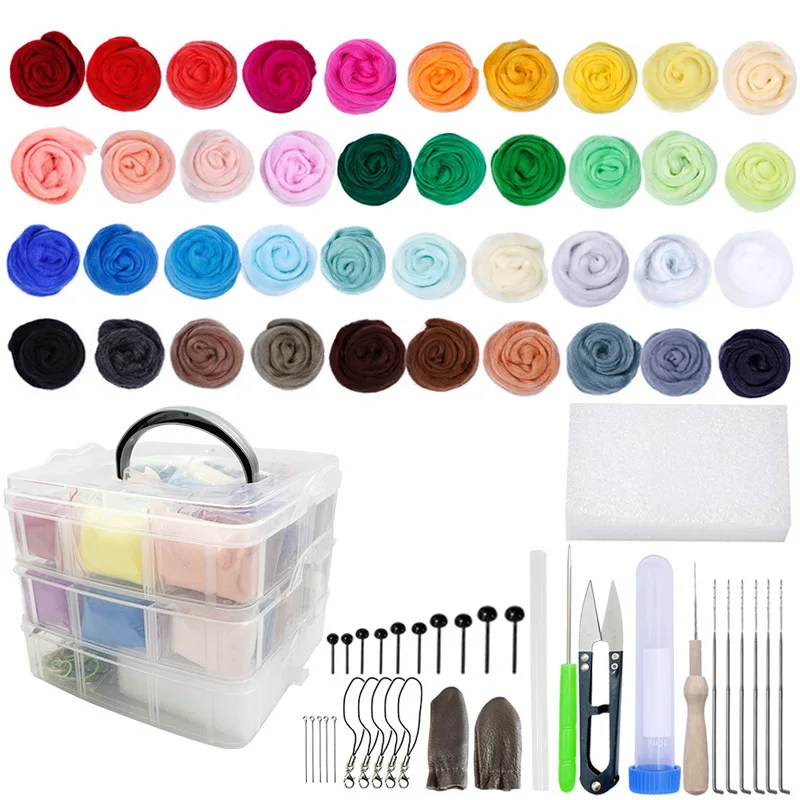
According to Hobbify Skills' needle felting guide, a practical starter kit requires varied needle gauges—coarser needles (around 36-gauge) for bulk rough shaping, and finer needles (38 to 40-gauge) for surface detailing—along with a protective work surface. This bundle checks those boxes by packaging multi-gauge needles in a protective storage tube, wooden handles, faux-leather finger protectors, snips, and basic hardware such as plastic safety eyes and lanyard cords.
Who it's for: Beginners who want to invent their own small ornaments, test multiple colorways, or need a replacement tool set with spare needles and basic storage.
Keep in mind: The individual wool color portions are small (often 3 to 5 grams each), meaning you cannot build large sculptures from a single shade without using uncolored core wool underneath.
Best 3D Miniature Project: DIY Handpoke Animal Kit
Sculpting in three dimensions is the most recognizable style of needle felting. A guided single-project animal kit is traditionally the easiest way to learn how to roll fiber into geometric cores, join limbs firmly, and apply detailed facial markings.
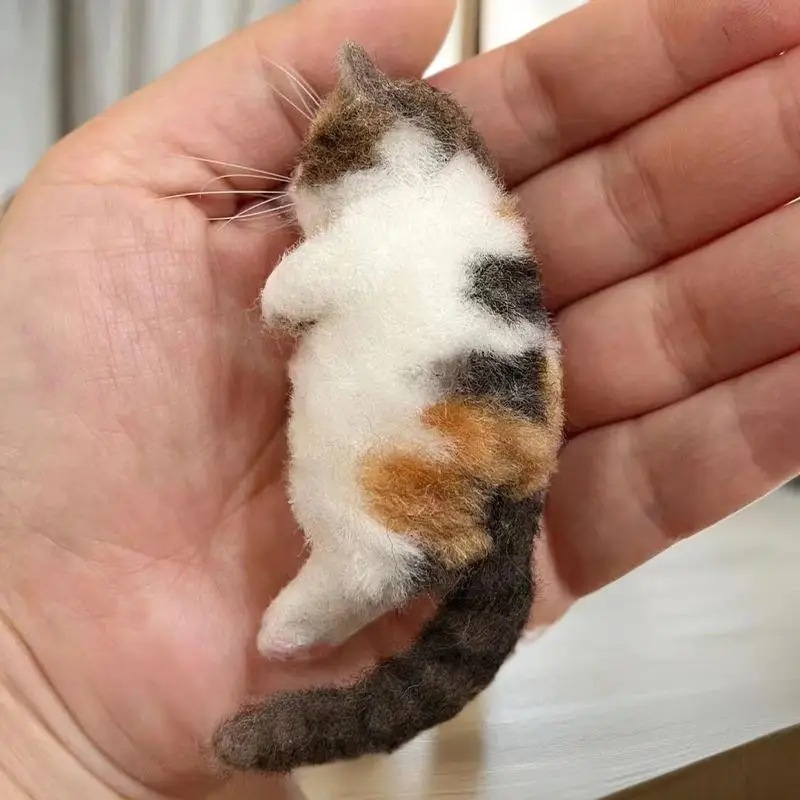
This kit focuses entirely on completing a miniature sculpted pet. Everything in the material bag is calibrated for the specific project: proportioned core fiber, realistic topcoat blends, whiskers, and basic felting needles. Focusing on a single figurine keeps you from feeling overwhelmed by endless wool bundles, helping you practice achieving proper firmness—a common stumbling block for novices who stop compacting their wool too early.
Who it's for: Crafters looking for a self-contained, single-evening project that teaches 3D form, part attachment, and surface blending.
Keep in mind: Animal kits require manual dexterity and patience to avoid finger pricks while shaping tight curves. Instructions are often concise photographic walkthroughs, so you may need a short online video tutorial to visualize the rolling technique.
Best Flat "Wool Painting" Kits: 2D Hoop Landscapes & Florals
If you are intimidated by sculpting freehand 3D shapes, two-dimensional needle felting—often called "wool painting"—is an accessible alternative. Instead of shaping floating fiber, you needle colored wool roving directly onto a pre-stamped felt or linen fabric backing held taut in an embroidery hoop.
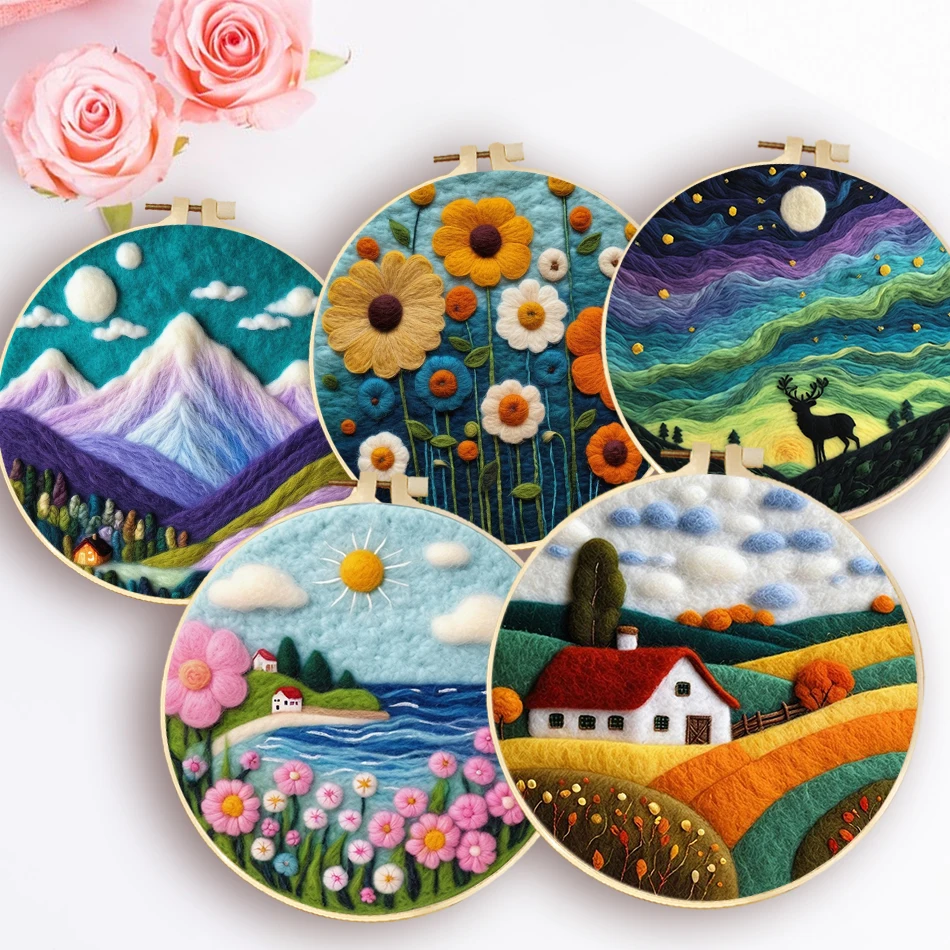
2D kits reduce needle breakage because the needle travels directly into a flat foam block behind the fabric without sideways torque. The GATYZTORY landscape series functions like paint-by-number: the pre-printed canvas marks out hills, skies, and horizons, allowing you to layer wool fibers to create textural gradients, clouds, and fields.

Similarly, the CHENISTORY botanical set provides framed floral and tree scenes. Working within an embroidery frame provides immediate structural support and doubles as a display frame once the piece is finished, eliminating the need to mount or stand a freehand sculpture.
Who 2D painting suits: Beginners who enjoy embroidery, coloring, or hoop art, as well as crafters seeking a relaxing, rhythmic project with a lower risk of broken needles.
How to Choose Between Budget Options
| Kit Type | Primary Advantage | Main Challenge | Best Suited For |
|---|---|---|---|
| Multi-Color Stash (Product 2) | Broad toolkit, finger guards, 40 distinct fiber hues | No guided step-by-step pattern included | Self-directed crafters, freestyle miniatures |
| 3D Animal Miniatures (Product 4) | Exact fiber measurements and specific design target | Requires sculpting balance; sharp needle hazard | Beginners focused on making small toys or gifts |
| 2D Wool Painting (Products 1 & 3) | Pre-stamped background fabric; frame included | Limited sculptural versatility (flat display only) | Visual artists, wall decor, low needle strain |
Three Practical Tips for Working with Cheap Kits
- Keep the needle angle uniform: Felting needles are made of tempered carbon steel. They are exceptionally hard along their vertical axis but brittle under lateral force. Always insert and withdraw the needle at the exact same angle—never lever or pry the fiber with the tip inside the work.
- Wear the finger guards: Inexpensive finger stalls (usually included in bundles like Product 2) may feel clunky, but barb pricks on thumbs and index fingers are the primary complaint among first-time felters. Wear them until your hand learns accurate stabbing boundaries.
- Work on a supportive surface: Budget foam pads compact quickly. Once the middle develops a deep hollow, either flip the pad over or rest it on a firm cutting mat so your needle does not pierce completely through into your work table.